The Lac Operon is an example of Enzyme Induction – when bacteria change the synthesis rates of specific enzymes in response to environmental changes. Here, the Lac Operon was theorised after experiments where glucose and lactose were given to E. Coli, which then used glucose before using lactose in two growth phases.
The enzyme E. Coli uses to process lactase is called (Beta) B-Galactosidase and Lactose Permease. B-Galactosidase catalyses the hydrolysis of lactose to glucose and galactose, whereas Lactose Permease transports lactose into cells.
The actual structure of the Lac Operon can be read as I-POZY, where:
I is a regulatory gene, and IS NOT part of the operon and is some distance away. I is used in the Lac Operon description to show the start of the process.
P – The Promoter region. This is DNA that RNA polymerase binds to, to transcribe the genes Z and Y.
O – The Operator region. A length of DNA sitting next to the structural genes (Z and Y). It can switch them on or off. The operator region is seen next to the promoter region in diagrams.
Z and Y – Structural Genes. Z codes for the enzyme B-Galactosidase, and Y codes for Lactose Permease.
TO TURN THE LAC OPERON OFF:
Step 1:
I, the regulatory gene, is transcribed and translated to produce a repressor protein. The protein can bind to lactose and to the operator region.
Step 2:
The repressor protein binds to the O-region, and in doing so covers the promoter region as well. This not only stops the operator region from switching Z and Y `on`, but also prevents RNA Polymerase from binding to P (which in turn stops production of the mRNA that codes for Z and Y).
Step 3:
Without the mRNA the B-Galactosidase and Lactose Permease cannot be created.
TO TURN THE LAC OPERON ON:
Step 1:
As above, the repressor protein is produced and binds to O, covering P also.
Step 2:
Lactose is now present. When lactose binds to the repressor protein they are both removed from O.
This frees O and P to do their own processes – that is, for RNA polymerase to bind to P to begin production of Z and Y, and O switches Z and Y on.
Step 3:
B-Galactosidase and Lactose Permease are now produced, and each act with the Lactose.
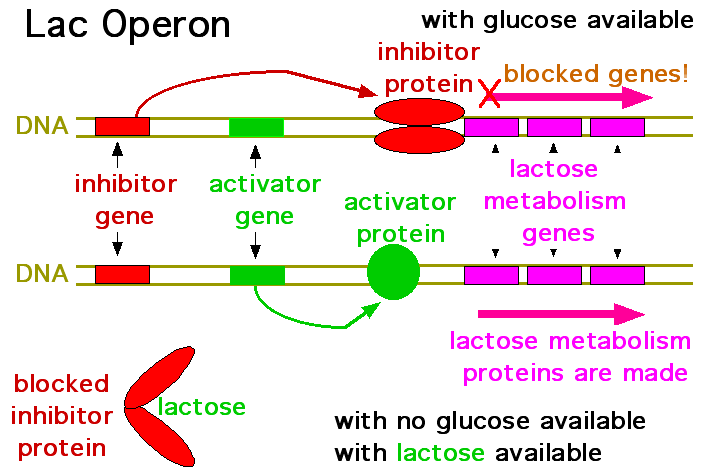
This diagram shows both `on` and `off`.
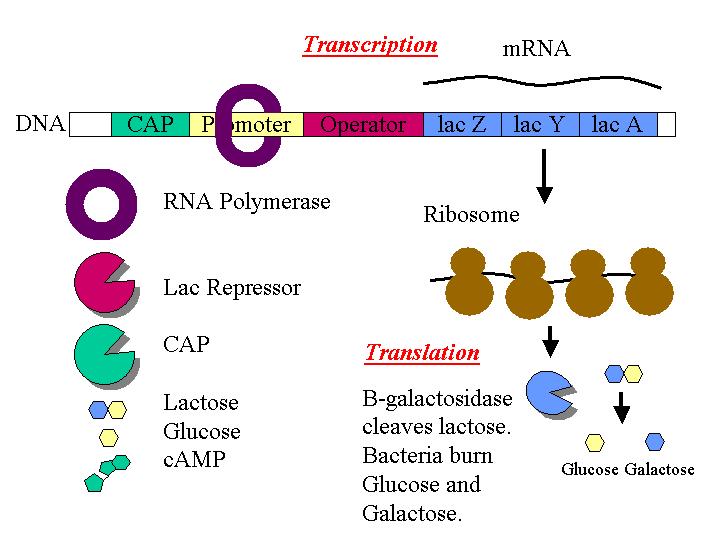
This diagram doesn't show the process, but is a good labelled picture of the seperate parts of the Operon. The CAP is the Regulatory Gene, I.


